Romanian Language: A Visitor's Phrasebook For Timisoara, Romania
Romanian is the official language of Timisoara, but this Banat city speaks more tongues than almost anywhere else in Romania. Here is the phrasebook that actually matters, section by section, plus honest advice on when you can simply use English.
Short answer
Romanian is the official language of Timisoara, and English is widely spoken in hotels, restaurants and the old town. Hungarian, German and Serbian are living minority languages in the city. A handful of Romanian phrases, greetings, thanks, restaurant and transport words, goes a long way with locals.
Timisoara, in Timis County in the Banat region of western Romania, is the kind of city where language is part of the sightseeing. The official language is Romanian, and the street signs, tram announcements and menus you will meet are all in it. But Timișoara, under its Hungarian historical name Temesvár and German name Temeswar, spent centuries as a multilingual Habsburg and Hungarian provincial capital, and that legacy is still audible: Hungarian, German and Serbian are all living languages here, spoken in homes, churches and theatres, not just in museum displays. This guide covers the Romanian that matters for a visit, phrase by phrase, and tells you honestly where English will carry you instead. For the broader picture of the city's languages, see the companion answer on what language is spoken in Timisoara, and for planning around the city itself, start with things to do in Timisoara.
What Language Is Spoken In Timisoara?
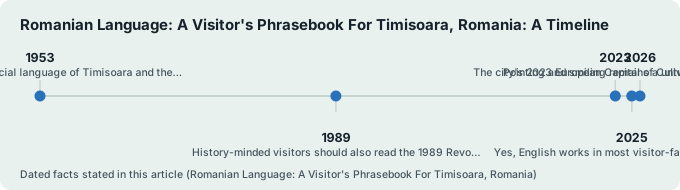
Romanian is the official language of Timisoara and the one you will hear everywhere, but the city is unusually multilingual for Romania: Hungarian, German and Serbian are all living minority languages here, and the city hall's own history list records that since 1953 Timisoara has been the only European city with three state theatres, performing in Romanian, Hungarian and German. English is widely understood in cafes, hotels and the old town, so a phrasebook is a courtesy here, not a survival tool.
Romanian is a Romance language, which surprises many first-time visitors. It descends from Latin, and if you speak Italian, Spanish or French you will recognize surprising amounts of it: "bună ziua" for good day, "apă" for water, "vin" for wine. The Slavic, Hungarian, German and Turkish words layered on top are a map of the region's history, and in Timisoara the German layer is unusually thick because the city was a Habsburg administrative center for two centuries.
The three-theatre fact is worth pausing on. A city that funds permanent state theatres in three languages is making a statement about itself, and you can hear it in the streets. In Elisabetin or Fabric you may catch Hungarian conversation at a market stall, German at a church service, or Serbian from families with roots across the border, which sits close enough that day trips into the Banat region are routine.
None of this changes what you should learn before arrival. Romanian is the language of the tram announcements, the museum labels, the restaurant menus and the bill. The sections below give you the working core of it.
Do People In Timisoara Speak English?
Yes, English works in most visitor-facing situations in Timisoara: hotels, restaurants in Cetate, museums and guided tours all commonly use it, and the city's tourist information centre reported that about 70% of the 4,928 visitors it served in 2025 were international, mostly from Germany, Serbia, France and Spain. Staff switch to English readily and without ceremony. Hungarian and German are also strong second languages locally, and Serbian is common given the border is close.
In practice, you can order confidently in English anywhere inside the old town and in most of the restaurants covered in the Timisoara restaurants guide. Younger staff under about 40 almost always have functional English; older patrons in neighborhood bars in Iosefin or Fabric may not, and that is exactly where a few Romanian phrases earn their keep.
The one place where language genuinely matters is the free walking tour scene. The Timisoara Essentials Tour with Alex, a free GuruWalk tip-based walk led by a local guide, is one of the best ways to hear everyday Romanian spoken at walking pace while getting your bearings; the guide's own commentary is in English, so you get both languages at once.
A useful fallback hierarchy, in order of what works: English first, German second, Italian or Spanish third (Romanian speakers often parse them on sight), Hungarian in a pinch in certain neighborhoods. Pointing and smiling remains a universal dialect, and Timisoara, named Romania's Destination of the Year 2026 at a national tourism gala, is a city that gets a lot of international visitors and has adjusted accordingly.
What Are The Essential Romanian Greetings And Politeness Phrases?
The essential Romanian greetings are "bună ziua" (good day, pronounced boo-nah ZEE-wah), "bună dimineața" (good morning), "bună seara" (good evening), "la revedere" (goodbye) and "mulțumesc" (thank you, pronounced mool-tsoo-mesk). Add "vă rog" (please), "scuze" (excuse me) and "nu înțeleg" (I don't understand), and you have the full politeness kit for Timisoara in nine phrases. Locals respond warmly even to imperfect attempts.
Romanian politeness runs on the formal "dumneavoastră" rather than the informal "tu" for strangers, and the phrases above are all safe formal forms. One detail worth knowing: "bună ziua" is used from late morning until dusk, and using it when entering a shop is expected, not optional. A shopkeeper will greet you first if you hesitate.
| English | Romanian | Rough pronunciation |
|---|---|---|
| Good day | Bună ziua | boo-nah ZEE-wah |
| Good morning | Bună dimineața | boo-nah dee-mee-NYA-tsa |
| Good evening | Bună seara | boo-nah SAY-ah-rah |
| Goodbye | La revedere | lah reh-veh-DEH-reh |
| Thank you | Mulțumesc | mool-tsoo-MESK |
| Please | Vă rog | vuh ROHG |
| Excuse me / sorry | Scuze | SKOO-zeh |
| Yes / no | Da / Nu | dah / noo |
| I don't understand | Nu înțeleg | noo oon-tse-LEHG |
| Do you speak English? | Vorbiți engleza? | vor-BEETS eng-GLEH-zah |
Diacritics are the main reading hurdle: the comma-below ș and ț sound like "sh" and "ts", and the breve ă is a mid-central vowel like the "a" in "about". Menus in tourist areas usually have English translations, but in neighborhood places around Trajan Square you may be reading Romanian only, so the food section below is the one to study hardest.
If you want a structured first hour in the city with someone to practice on, The Classic Tour of Timisoara covers the main squares at a pace that leaves room for questions, and guides are patient with visitors testing their pronunciation on street names.
How Do You Order Food And Drink In Romanian In Timisoara?
To order in Romanian, use "aș dori" (I would like) or the simpler "o cafea, vă rog" (a coffee, please), then "nota de plată, vă rog" to ask for the bill. The core restaurant vocabulary is "meniu" (menu), "apă" (water), "bere" (beer), "vin" (wine), "mâncare" (food) and "delicios" (delicious). In the old town and the restaurants of Cetate, English menus are common, but in neighborhood kitchens Romanian is the working language.
Timisoara's food scene rewards the effort. The city sits in the Banat, a region whose cooking mixes Romanian, Hungarian, German and Serbian traditions, and the dish names on menus reflect that: you will see Hungarian-influenced goulash preparations alongside sarmale (cabbage rolls) and mămăligă (polenta). The Timisoara food guide maps the specialties; the phrases below get them onto your table.
| English | Romanian | Rough pronunciation |
|---|---|---|
| The menu, please | Meniul, vă rog | meh-NEE-ool vuh ROHG |
| I would like... | Aș dori... | uhsh DOH-ree |
| A coffee / a beer | O cafea / o bere | oh kah-FEH-ah / oh BEH-reh |
| Still or sparkling water | Apă plată sau carbogazoasă | AH-pah PLAH-tah sow kar-bo-gah-ZOH-ah |
| Wine (red / white) | Vin (roșu / alb) | veen ROH-shoo / alb |
| The bill, please | Nota de plată, vă rog | NOH-tah deh PLAH-tah vuh ROHG |
| It was delicious | A fost delicios | ah fohst deh-lee-CHOHS |
| Without meat | Fără carne | FAH-rah KAR-neh |
| Breakfast / lunch / dinner | Mic dejun / prânz / cină | meek deh-ZHOON / prinz / CHEE-nah |
Prices help you plan even before you order: a cappuccino in Timisoara typically runs 13 to 15 RON and a half-liter of domestic draft beer 11 to 12 RON, per September 2026 cost-of-living trackers, though every venue sets its own prices, so treat these as planning ranges and check the menu. Tipping is customary: rounding up or leaving roughly ten percent in cash is the local norm.
What Romanian Phrases Help With Transport In Timisoara?
For transport in Timisoara, the phrases that matter are "o bilet, vă rog" (one ticket, please), "ce linie merge la...?" (which line goes to...?) and "unde este stația de tramvai?" (where is the tram stop?). The city runs trams, trolleybuses, buses and a seasonal vaporetto on the Bega, and a single 60-minute ticket costs 5 lei, payable by contactless card on board. Announcements are in Romanian, so knowing your stop's name is the real skill.
The tram network is the backbone of the city, nine lines strong, and the getting around Timisoara guide covers routes and tickets in full. Language-wise, three things catch visitors out. First, stop names are announced in Romanian only, so learn to recognize yours: "Piața Unirii" for the main square, "Piața Victoriei" for Victory Square. Second, the day pass is 18 lei and covers all modes including the vaporetto, which is a genuinely pleasant way to see the city from the water. Third, the ticket machines and kiosks have some English, but drivers and inspectors generally do not.
| English | Romanian | Rough pronunciation |
|---|---|---|
| One ticket, please | Un bilet, vă rog | oon bee-LEHT vuh ROHG |
| Tram / bus / trolleybus | Tramvai / autobuz / troleibuz | tram-VYE / ow-toh-BOOZ / troh-LAY-booz |
| Where is the stop? | Unde este stația? | OON-deh YES-teh STAH-tsee-ah |
| Which line goes to the airport? | Ce linie merge la aeroport? | cheh LEE-neh MER-geh lah ah-eh-roh-PORT |
| Does this go to...? | Aceasta merge la...? | ah-CHYAH-stah MER-geh lah |
| One more stop / get off here | Încă o stație / cobor aici | OON-kuh oh STAH-tsee-eh / koh-BOR ah-EECH |
Taxis and ride-hailing remove most of the language problem, since apps handle the address; the Timisoara taxi and rideshare guide explains the local setup. For the airport run, express bus E4 connects the city to Traian Vuia airport, and the airport to city center guide has the details. If you plan to drive yourself instead, the car rental guide covers what the road signs, which are of course in Romanian, will be telling you.
How Do Numbers, Money And Shopping Phrases Work In Romanian?
Romanian numbers are straightforward once you learn the pattern: unu, doi, trei, patru, cinci, șase, șapte, opt, nouă, zece (one to ten), and "cât costă?" means how much does it cost. The currency is the Romanian leu (RON), not the euro, and prices are marked in lei everywhere in Timisoara. Card payment is normal in shops and restaurants, but market stalls and small kiosks often expect cash.
Learning one to ten gets you most of the way, because prices under one hundred are built from them: douăzeci (20), treizeci (30), and so on follow a regular pattern. For anything else, the shop's card terminal displays the total, so reading digits is a valid strategy.
| English | Romanian | Rough pronunciation |
|---|---|---|
| One to five | unu, doi, trei, patru, cinci | OO-noo, doy, tray, PAH-troo, CHEENCH |
| Six to ten | șase, șapte, opt, nouă, zece | SHAH-seh, SHAHP-teh, ohpt, NOH-uh, ZEH-cheh |
| Twenty / fifty / one hundred | douăzeci / cincizeci / o sută | doo-uh-ZETCH / cheench-ZETCH / oh SOO-tuh |
| How much does it cost? | Cât costă? | koont KOHS-tuh |
| Too expensive | Prea scump | prah SKOOMP |
| Can I pay by card? | Pot plăti cu cardul? | poht pluh-TEE koo KAR-dool |
| Do you have...? | Aveți...? | ah-VEHTS |
| The receipt, please | Bonul, vă rog | BOH-nool vuh ROHG |
The Romanian currency guide explains the leu, exchange and card use in depth, and the cost and prices guide budgets a whole trip. One number worth knowing before you check into any accommodation: Timisoara collects a local tourist tax, reported at 2% of the nightly accommodation tariff excluding VAT, set by council decision HCL 719/2025 and collected by the lodging, so it appears on your hotel bill rather than being paid separately.
What Are The Emergency And Help Phrases In Romanian?
The emergency number in Romania is 112, and it connects to police, ambulance and fire services with English-speaking operators available. The phrases that matter are "ajutor" (help), "unde este spitalul?" (where is the hospital?), "am pierdut..." (I have lost...) and "vorbiți engleza?" (do you speak English?). Timisoara is a safe, walkable city where these phrases are more likely to be needed for a lost phone than anything else.
The is Timisoara safe guide covers the practicalities, and the honest summary is that violent crime against visitors is rare and the main risks are the ordinary ones of any city: unattended bags and tram pickpockets at rush hour. Still, the phrases below cost nothing to learn.
| English | Romanian | Rough pronunciation |
|---|---|---|
| Help! | Ajutor! | ah-ZHOO-tohr |
| Call the police / an ambulance | Chemati poliția / salvarea | keh-MAH-tee poh-LEE-tsee-ah / sal-VAH-reh-ah |
| I have lost my passport | Am pierdut pașaportul | ahm pyer-DOOT pah-shah-PORT-ool |
| Where is the pharmacy? | Unde este farmacia? | OON-deh YES-teh far-mah-CHEE-ah |
| I need a doctor | Am nevoie de doctor | ahm neh-VOY-eh deh DOK-tohr |
| I don't speak Romanian well | Nu vorbesc bine românește | noo vor-BESK BEE-neh ro-moo-NES-keh |
Pharmacies ("farmacii") are plentiful and marked with a green cross, and pharmacists in the center commonly manage in English. For embassy and document matters, the Romania travel essentials guide collects the contacts and entry rules in one place, including the Schengen context: Romania is a full Schengen member, with land borders open since 1 January 2025, so EU visitors cross from Hungary with no routine checks, while the Serbian border remains an external Schengen frontier with passport control and the EU's biometric Entry/Exit System, fully operational since 10 April 2026.
How Hard Is Romanian To Learn Before A Timisoara Trip?
Romanian is moderately easy for English speakers to get started in, because it is a Romance language with familiar vocabulary roots, but its grammar has case endings that take real study. For a Timisoara trip, the practical bar is low: about thirty phrases, the pronunciation rules for ș, ț and ă, and number recognition cover almost every interaction. Reading menu and street Romanian is achievable in an afternoon; holding a conversation is a months-long project.
Pronunciation is more regular than English, which helps. Stress usually falls on the last syllable or second-to-last, vowels are consistent, and once you internalize that "ce" sounds like "che" in "check" and "ci" like "chi" in "chip", street names stop being intimidating. Ceașcov, the local word for the covered market area, becomes pronounceable.
| Written | Sounds like | Example |
|---|---|---|
| ș | "sh" in ship | șapte (seven) |
| ț | "ts" in cats | mulțumesc (thank you) |
| ă | "a" in about | bună (good) |
| â / î | a tight "ee" from the back | mână (hand) |
| ce / ci | "che" / "chi" | cetate (fortress), cinci (five) |
| ge / gi | "je" / "ji" | gel (gel), ginere (son-in-law) |
For listening practice before you go, the city's own cultural output is a good source: the Romanian National Opera's program is published online, and the opera guide explains what is playing where. Language apps and the Romanian service of Radio Romania both work for ear training. And once you are on the ground, the single best practice environment is a guided walk, because the guide speaks slowly, repeats willingly, and corrects gently.
What Local Words Make Timisoara's Romanian Different?
Timisoara's Romanian carries a distinct Banat regional flavor: locals say "pai" (well, so) as an all-purpose conversation starter, borrow words freely from Hungarian and German, and pronounce the language with a softer, more western intonation than Bucharest Romanian. The city's history as Temesvár and Temeswar left German and Hungarian traces in street food names, building vocabulary and everyday slang. Even Romanian visitors from other regions notice the accent within a sentence or two.
The Banat was historically one of Europe's most mixed regions, and its language shows it. Do not be surprised to hear "servus" as a casual hello, an import from Habsburg days used across the old monarchy, or to see German-derived shop names in the old town. The city's 2023 European Capital of Culture year, which it shared with Elefsina and Veszprem, put this multilingual identity on stage, and the European Capital of Culture guide tells that story.
Practically, this means your phrasebook Romanian will be understood everywhere, and any attempt to use it will be met with encouragement rather than correction. The neighborhoods where everyday, non-tourist Romanian is easiest to hear are Elisabetin and Iosefin, where the cafe and market culture is local first; the Elisabetin and Iosefin guides map them. History-minded visitors should also read the 1989 Revolution guide, because the revolution's vocabulary, "revoluție", "libertate", "memorial", appears on plaques all over the city.
If your trip stretches beyond the city, the same Romanian carries into the countryside, and guided day trips are a good place to use it with a safety net.
Common Questions About The Romanian Language In Timisoara
Is Romanian a Slavic language?
No. Romanian is a Romance language descended from Latin, related to Italian, Spanish, French and Portuguese. It has borrowed vocabulary from Slavic languages, Hungarian, Turkish and German over the centuries, which is why some words look unfamiliar, but its grammar and core vocabulary are Latin-based.
Do I need Romanian in Timisoara if I speak English?
No, you can complete a visit to Timisoara entirely in English in hotels, restaurants and attractions. Learning greetings, thanks and a few restaurant phrases improves interactions with locals, and becomes more useful in neighborhood areas outside the old town.
Is Hungarian or German useful in Timisoara?
Both are recognized minority languages with real local presence, including a permanent state theatre in each. German is understood by some older residents, Hungarian by a substantial community. English remains the more reliable second language for visitors.
How do you say thank you in Romanian?
Mulțumesc, pronounced roughly mool-tsoo-MESK. The casual short form is "mersi", borrowed from French, and it is extremely common in everyday Timisoara conversation.
What does "Servus" mean in Timisoara?
It is a casual hello or goodbye inherited from the Habsburg era and used across the former monarchy's lands. In Timisoara you will hear it between friends as an informal greeting, and using it yourself is a nice local touch.
Are Timisoara's street signs hard to read?
They use the Romanian Latin alphabet with five extra diacritic letters, and pronunciation rules are consistent, so reading becomes easy quickly. The main trick is that "ce" sounds like "che" and "ci" like "chi", after which names like Cetate and Calea are straightforward.
A final word on timing: the best time to visit Timisoara guide helps you pick your season, and whichever you choose, the phrases in this guide will serve you from the airport bus to the last "la revedere" at the tram stop. This Timisoara Travel Guide covers everything else you need, from where to sleep to what to eat, and the Romanian will come faster than you expect once you are hearing it all day.